




Tanzanie

Le Réseau local tanzanien a été créé en 2024 et est piloté par l'Association des acteurs non étatiques (ANSAF). La Tanzanie compte plus de 2 000 coopératives agricoles, regroupant plus de 1,8 million de membres. Il s'agit principalement de petits exploitants agricoles. La Tanzanie met en œuvre l'Agenda 10/30 pour la transformation de l'agriculture par la commercialisation. Pour atteindre cet objectif, le gouvernement, par l'intermédiaire du Conseil national pour l'autonomisation économique (NEEC), collabore avec les parties prenantes afin d'élaborer des directives nationales sur les BDS afin de normaliser les services à l'échelle nationale.
L'AMEA cherche à contribuer à ces objectifs en abordant des questions clés, telles que la fiabilité et la qualité du service de développement commercial (BDS), le coût du BDS, l'environnement propice aux fournisseurs de BDS, la demande de BDS et la coordination des fournisseurs de BDS (BDSP).
Tanzania BDS Vision
The National BDS Roadmap was launched in 2025 by the National Economic Empowerment Council (NEEC).
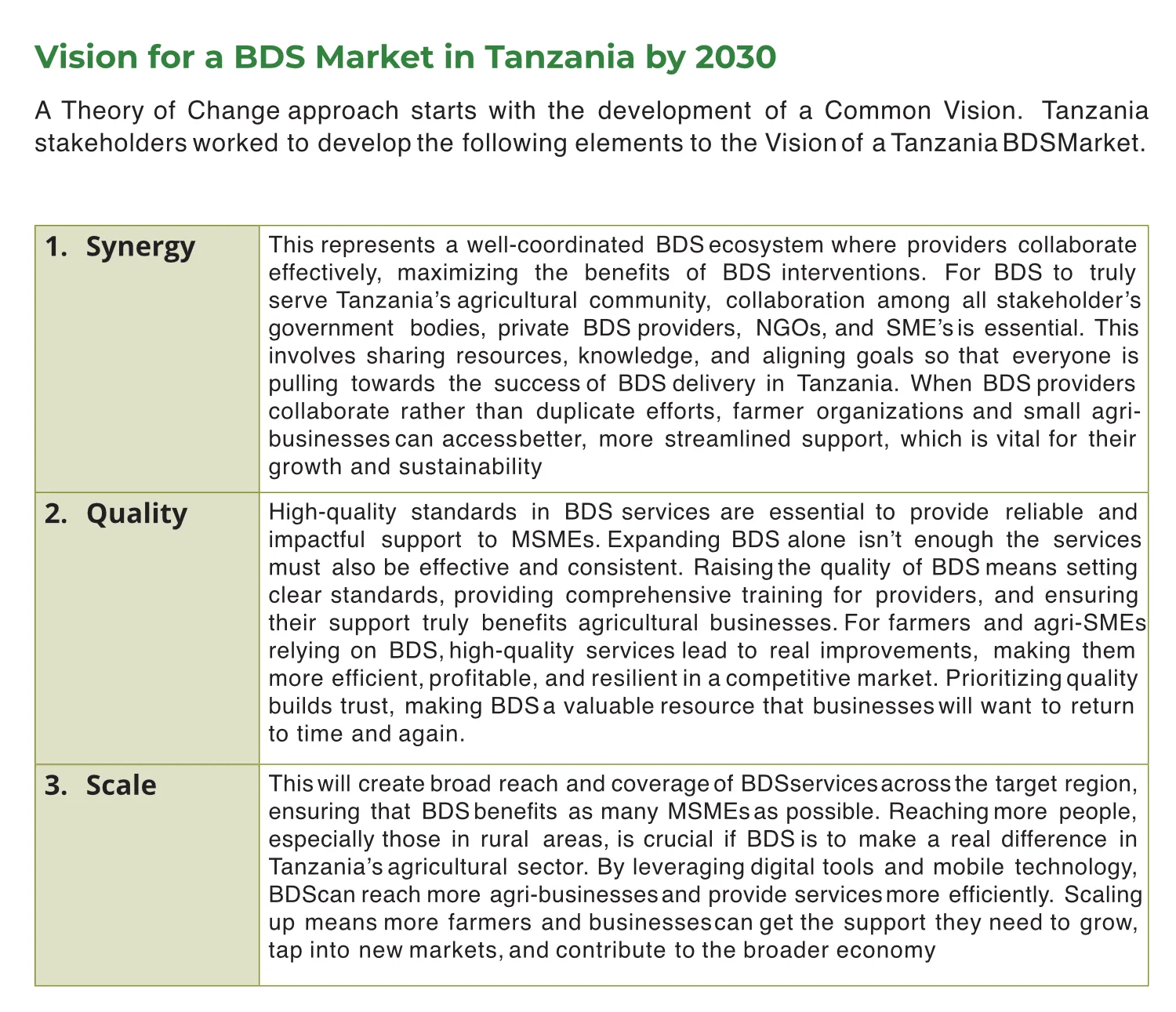
The Roadmap identifies three priority actions which would have the greatest impact:

Certifying BDSPs
Establishing a credible certification system for Business Development Service Providers (BDSPs) ensures that providers meet consistent minimum quality standards. With the creation of a BDS Association, BDSPs would be certified based on predefined quality metrics, helping agricultural businesses to identify trustworthy service providers and fostering a more structured support network. This system aims to ensure most of the commissioned BDSPs are certified, elevating dilligence, reliability and professional standards in the sector.

Standardised Data on BDS Cost Effectiveness
The roadmap advocates for collecting and sharing data on BDS cost-effectiveness across various initiatives. By generating uniform data, stakeholders can assess the impact and efficiency of BDS, facilitating evidence-based learning and continuous improvement. This initiative will promote transparency, trust, improve collaboration, and foster a knowledge-sharing culture that helps optimising resource allocation and enhance effectiveness of BDS Interventions.

BDS Cost share facilities
The roadmap calls for larger-scale cost-sharing facilities, supported by both government and donors, to make BDS more accessible to agricultural SMEs. These facilities would not only subsidise the cost of services but also contribute to improving BDSP quality through training and professional development programs. This broader support system would help scale up the reach and impact of BDS, ensuring that rural and underserved areas benefit from these services, thus promoting equitable access to BDS in Tanzania.
Téléchargements

Tanzania BDS Roadmap
National BDS Guidelines
Our Members

TAPBDS
Member Type: Local
Headquarters Tanzanie

MEDA
Member Type: Local
Headquarters Canada

Cordaid
Member Type: Founding, Global
Headquarters The Netherlands

IDH
Member Type: Founding, Global
Headquarters The Netherlands

SFI
Member Type: Founding, Global
Headquarters Washington, D.C.

Rikolto
Member Type: Founding, Global
Headquarters Belgium

AGRA
Member Type: Global
Headquarters Kenya

Corus International
Member Type: Global
Headquarters Washington, D.C.

ANSAF
Member Type: Local
Headquarters Tanzanie

IMED Limitée
Member Type: Local
Headquarters Tanzanie

NEEC
Member Type: Partenaire stratégique
Headquarters Tanzanie

TADB
Member Type: Partenaire stratégique
Headquarters Tanzanie

TCDC
Member Type: Partenaire stratégique
Headquarters Tanzanie
Latest Tanzania Updates
News, Case Studies, Resources & Events from the Tanzania Local Network
Étude de cas BICHOBS Tanzanie Horticulture LIA
Rikolto’s BICHOBS project reached nearly 28,400 farmers across Tanzania’s Southern Highlands. AMEA’s latest Learning into Action case study unpacks what […]

Bienvenue à TAPBDS, notre nouveau membre du réseau
L-IFT join us as a global member because it wants to become part of this network that jointly addresses agricultural […]
Bienvenue à IMED en tant que nouveau membre de notre réseau
L-IFT join us as a global member because it wants to become part of this network that jointly addresses agricultural […]
Feuille de route pour la Tanzanie
AMEA Tanzania, in partnership with the National Economic Empowerment Council (NEEC), is proud to present a transformative Strategic Roadmap for […]
Bienvenue à Sundy Merchants en tant que nouveau membre de notre réseau !
We are excited to welcome Sundy Merchants Company Ltd. as the newest member of the AMEA network! Sundy Merchants brings […]
Bienvenue à ANSAF en tant que nouveau membre de notre réseau !
We are excited to welcome ANSAF as the newest member of the AMEA network! ANSAF, the Agricultural Non-State Actors Forum, is a […]
Network Facilitator

Witness Shia Kabalata