




Public agricultural projects have long been good at building production and irrigation infrastructure. They have been far less successful at helping smallholder cooperatives become commercially viable enterprises. Rwanda's Sustainable Agricultural Intensification and Food Security Project (SAIP I, 2018 to 2024) set out to close that gap.
SAIP I was a US$38.7m project, financed mainly by the Global Agriculture and Food Security Program (GAFSP) and implemented by the Rwanda Agriculture and Animal Resources Board (RAB). Our latest Learning into Action case study focuses on its market-access objective. Under that objective, a US$12.77m tiered matching-grant facility was combined with a wide package of business development services (BDS). These included cooperative governance and business-plan training, FAO's Farming as a Business approach, product certification and structured buyer–producer linkage events. Delivery used a Public–Private–Producer Partnership (4P) model, with the Development Bank of Rwanda (BRD) managing grant disbursement and verification.
Beneficiaries were active co-investors, not passive grant recipients. Enterprises and cooperatives raised roughly US$4.34m of their own counterpart funding through in-kind assets such as land, SACCO and member-savings loans, and commercial or asset-backed finance.
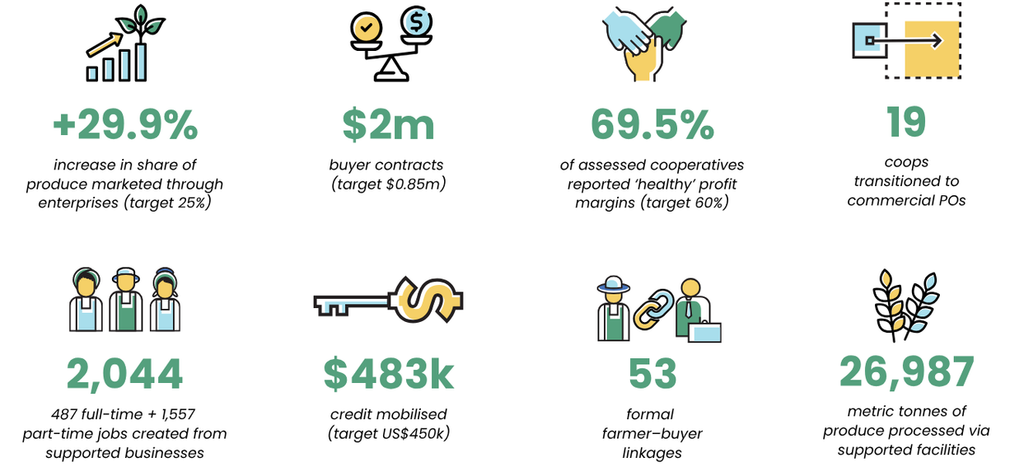
Results at a glance
SAIP I overachieved on most of its targets, and the World Bank rated its overall outcome Highly Satisfactory.
What we learned
- BDS and capital worked as one instrument, not two. The gains came from combining the matching grant with business-plan support, Farming as a Business training and market-linkage brokering. A market orientation from the start, and strategic partnerships such as the one with WFP, opened new markets for producers.
- Segmenting by maturity made sense, but the evidence is thin. Support was tiered from basic (inputs, irrigation) to intermediate (governance) to advanced (business planning, market linkage, finance). Only 19 of 2,397 organisations reached the commercial tier. Field visits show that even enterprises meeting their matching-grant targets still face buyer scepticism and member side-selling. Clear graduation criteria and tracking would show how far BDS speeds up the climb.
- Cost-sharing works, but it needs flexibility. The facility aimed for enterprises to contribute 50% of investment costs. In practice, most agri-processors received grants of 70 to 75%, and cooperatives received 90%. Cost-share ratios matched to investment type and enterprise capacity proved essential.
- Tight financial controls bought quality but cost speed. Routing disbursement and verification through BRD reduced the misuse of funds and low-quality procurement seen in earlier projects. It also added delays, which sometimes meant funds and equipment arrived after critical planting and processing windows.
- Governance is the binding constraint on sustainability. Weak reporting, leadership conflict and side-selling came up repeatedly. Governance, not technology, decides whether commercialisation gains last. Stronger capacity at the Rwanda Cooperative Agency, supported by tools such as a Cooperative Governance Scorecard, would make governance quality as visible as commercial performance.
- Access to finance remains the unfinished agenda. Matching grants alone will not complete the transition from subsistence to market. Farmers and their enterprises need working capital and a route to commercial credit, which SAIP II and the parallel CDAT project are now working on.
- Better data is needed to judge effectiveness. SAIP I clearly delivered short-term results. Understanding which parts of the BDS package drove those results needs enterprise-level data on revenue, jobs, certification and finance. ISO 18716, the International Standards Organization's standard for professional farmer organisations, offers a framework for building that dataset in future projects.
What this means for the sector
- Donors and funding agencies should treat BDS as a core pillar of agri-commercialisation finance, not a bolt-on. They should fund enterprise-level results measurement from the outset and pair matching grants with a route to commercial credit.
- Senior technical advisors and implementers should formalise maturity-based segmentation with explicit graduation criteria, and put governance strengthening before grant disbursement, not after. Financial controls need to protect funds without slowing delivery. Asset insurance and pooled supply contracts should become standard grant conditions.
- Policy makers and ecosystem actors should build local BDS and certification capacity, strengthen the institutions that oversee cooperative governance, and bring financial institutions in early so that commercialisation is matched by financial deepening.
Read the full case study
The full case study sets out the detailed evidence behind each finding, the open questions for SAIP II, and recommendations for each stakeholder group, with a named lead actor for each action.
This case study is part of AMEA's Learning into Action series, which captures practical lessons on professionalising farmer organisations and agri-SMEs. It draws on the RAB SAIP I Final ICRR (August 2024), the World Bank Implementation Completion and Results Report (February 2025), the Independent Evaluation Group ICR Review (May 2025), and field interviews in 2026 with the SAIP/RAB Project Coordinator and seven producer organisations, buyers and agri-SMEs across five districts.