




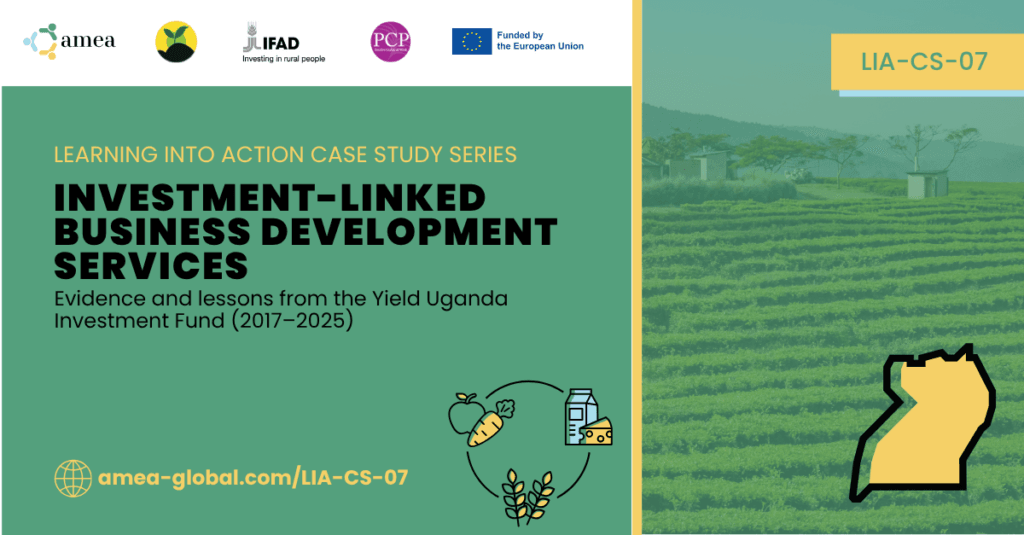
Capital Alone Isn't Enough: What Eight Years of Blended Finance in Uganda Taught Us About Business Development Services
For nearly a decade, most impact funds providing patient capital to African agri-SMEs have been managed from outside the continent. The Yield Uganda Investment Fund set out to test something different: could a locally based impact fund work, and could it attract local capital investors alongside international ones?
Launched in 2017 by the European Union in partnership with IFAD, and managed by Pearl Capital Partners (PCP), the Fund combined equity, semi-equity and debt with a structured Business Development Services (BDS) facility. Uganda's National Social Security Fund came in as a co-investor, growing the Fund from an initial €10m EU commitment to a €20m facility. Over its life, the Fund invested €19.6m across 15 Ugandan agri-SMEs spanning dairy, seed, horticulture, vanilla, animal feed and processed foods.
The results, drawn from AMEA's Learning into Action case study series, offer some of the clearest evidence yet on how investment and BDS work together, and where the model still needs refining.
BDS and capital need each other
Yield Fund was built on a hard-won premise. Two earlier funds had already shown that capital without BDS produced weak outcomes, and BDS without capital access failed to deliver either. So Yield Fund deliberately bundled the two, using BDS to de-risk investments and unlock the constraints holding enterprises back from growth.
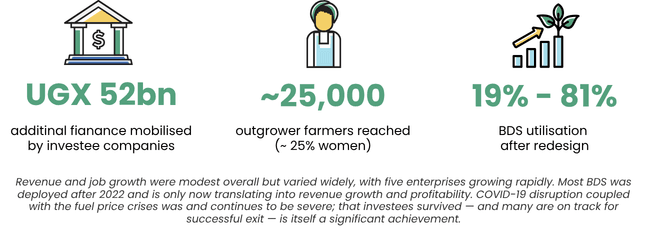
It worked, but not evenly. The investee companies mobilised an additional UGX 52bn in finance and reached approximately 25,000 outgrower farmers, around a quarter of them women. Revenue and job growth varied widely across the portfolio, with five enterprises growing rapidly while others progressed more slowly, a pattern shaped as much by COVID-19 disruption and fuel price shocks as by the support itself.
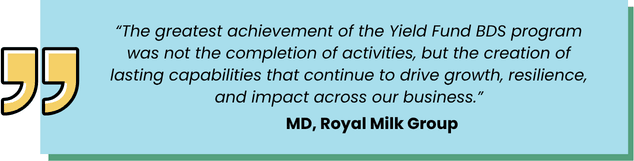
As one investee, the MD of Royal Milk Group, put it: "The greatest achievement of the Yield Fund BDS program was not the completion of activities, but the creation of lasting capabilities that continue to drive growth, resilience, and impact across our business."
What the evidence shows
A few findings stand out from the detailed evidence base:
- BDS is most powerful when fused with the investment process. It consistently improved investment readiness, governance and access to finance, though its effect on short-term revenue depended more on market conditions and SME maturity.
- The capital partner, not the BDS manager, shaped the plan that mattered most. Investees consistently named PCP as their deepest source of strategic advice. The BDS Management Company's real value lay elsewhere: rigorous procurement, quality assurance and keeping spending decisions at arm's length from the capital partner.
- Cost-sharing needed to flex with reality. The original 50/50 cost split between Fund and enterprise was revised to 85/15 during COVID, when working capital was severely constrained. Utilisation rose from 19% to 81% once Friends Consult Ltd took over BDS delivery in 2022 with a more hands-on approach. Every enterprise now confirms it is willing to pay a contribution, but the underlying six-step claims process was consistently flagged as too cumbersome.
- Pre-investment BDS could lift the whole portfolio. Half of the investees had received no prior BDS before joining the Fund, and Friends Consult Ltd judged that two-thirds of the portfolio would have benefited from earlier governance and management support before capital was even committed.
- The accredited provider database is now a public asset. Building a database of 146 pre-qualified BDS providers across seven service areas was funded publicly. Sharing it more widely could help address one of the most persistent challenges AMEA hears from its network: finding high-quality BDS providers in the first place.
Extending these learnings beyond Uganda
The investment-linked BDS architecture behind Yield Fund, a capital partner with sectoral expertise, a hands-on BDS manager, a pre-qualified provider database and a flexible, co-created support plan, is highly replicable across countries and value chains. But the case study is candid that a 14% BDS-to-investment ratio is not, on its own, enough to transform food systems at scale.
That is precisely the kind of evidence AMEA's BDS market system propositions call for: standards, guiding principles, and data sharing that let the sector learn from what works and stop investing in what doesn't. Yield Fund's experience, still being tracked until the Fund closes in 2027, is a valuable data point in that ongoing effort to professionalise how BDS gets designed, funded and delivered.
Read the full LIA-CS-07 case study, including detailed evidence and recommendations for donors, implementers and policymakers, on the AMEA website.