




Evidence from Kenya's DREEM Project
What happens when refugee-led and host-community enterprises receive capital and business development services (BDS) together, rather than one or the other? The ninth case study in AMEA's Learning into Action series, LIA-CS-09, looks at the evidence from Kenya's DREEM project. The answer from the entrepreneurs themselves is clear: the grant and the coaching did different jobs, and neither would have delivered the same results alone.
About the DREEM project
The Displaced and Refugee Youth Enabling Environment Mechanism (DREEM) project was implemented by Farm Africa and funded by the Mastercard Foundation, in partnership with World University Service of Canada (WUSC). Running from August 2022 to August 2025, it set out to strengthen refugee-led and host-community micro and small enterprises in Kakuma and Kalobeyei, Kenya.
At its core was an Innovation Fund that combined cash or in-kind grants (stock and equipment) with tailored one-on-one coaching, classroom training, peer mentorship and market linkages. Enterprises were selected through a business innovation competition.
This case study focuses on the first two cohorts, which completed the full package from start to finish:
- Cohort 1: 63 micro-enterprises, 73% refugee-owned
- Cohort 2: 42 small enterprises, 57% host-community-owned
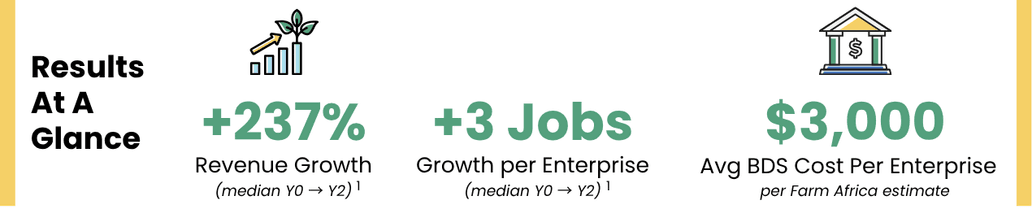
- +237% median revenue growth (Year 0 to Year 2)
- +3 jobs per enterprise (median, Year 0 to Year 2)
- $3,000 average BDS cost per enterprise (Farm Africa estimate)
These medians cover the 70 of 93 enterprises with two years of data following baseline. Farm Africa's own cohort-level monitoring reported average monthly sales increasing by 138% for Cohort 1 and 36% for Cohort 2.
What we learned
1. Casting a wide net comes at a cost
More than 1,000 enterprises applied for Cohort 1, and 300 were selected for due diligence. Better community sensitisation, an easily shared digital application form and clearer messaging drove a further surge of applications for Cohort 2. The messaging changes reassured Muslim business owners that the programme was not asking them to take out loans. But screening was intensive. It required physical visits to business premises, and staff faced pressure to complete three due diligences a day. Future programmes need to weigh the benefits of a larger applicant pool against the efficiency and quality of selection.
2. Entrepreneurs prefer on-site, one-on-one coaching
Farm Africa's Enterprise Capacity Assessment Tool (ECAT) identified capacity gaps at onboarding and shaped a tiered approach. Cohort 1 received group classroom training plus one-on-one coaching, while the more established Cohort 2 businesses received one-on-one coaching only.
The entrepreneurs interviewed consistently valued coaching delivered at their own premises most.
"What I found the most important was the one-on-one session we had during the coaching, because it was easy having a coach at your business premises - it was a practical session. You talk to someone about what is happening, and they can see it, and give proper advice." - Vincent, Founder, Green at Mind (Cohort 1)
Group sessions still offered valuable peer learning and networking. Comparing the cost-effectiveness of the two approaches was beyond the scope of this study.
3. Grants and BDS work as a single instrument
It would be easy to read this evidence as a case for BDS over capital. The entrepreneurs do not see it that way. Yakub, who runs a wholesale food business in Kakuma, estimated that the grant and the training contributed in roughly equal measure to his growth. The grant gave the business something to sell; training in inventory, invoicing, customer attraction and bookkeeping turned that stock into a growing business rather than a one-time injection that faded.
For Peter Kimutai of Musug Technologies, the grant supplied stock he could not have financed through a bank at the time. But it was the record-keeping and financial reporting skills built through BDS that gave him the confidence to invest his savings in a separate venture and grow his workforce to 36 people.
4. Business discipline is the lasting legacy
Across both cohorts, entrepreneurs named record-keeping and investment planning as the most durable takeaway from coaching. Peter Kimutai summed up the shift:
"There are some things that I took for granted in the past, but now I always take them seriously." - Peter Kimutai, Founder, Musug Technologies (Cohort 1)
Better records gave him a credit history he could draw on if needed. In Cohort 2, one entrepreneur described moving from opening her business just to survive day to day, to having a clear direction and goals to work towards.
5. Timing shaped resilience
Cohort 1's stronger growth is partly a timing story. It received its grant and BDS in 2023, well before two major shocks hit the local economy: the March 2025 withdrawal of UNHCR's Bamba Chakula cash-transfer programme and the broader pullback of USAID-funded activity in the region. Cohort 2, onboarded later, had less time to build a buffer. Neither shock was anticipated in the original programme design.
Replicating the model: what should change
The DREEM architecture, a grant paired with tiered BDS, is a strong template for refugee-hosting and host-community contexts. The case study identifies five design changes for future programmes:
- Recruit all cohorts at the start, not in staggered waves, making selection more efficient and targeted so every enterprise receives at least two years of support.
- Decide early between a growth and an inclusion focus. DREEM's focus on high growth excluded many women-led businesses, and the project responded by onboarding a fifth, women-centric cohort. (AMEA's India FPO case study explores the same trade-off.)
- Invest in group and coaching processes that reinforce each other, recognising that expanding one-on-one mentoring would raise costs significantly.
- Cap the onboarding-to-disbursement window at three months. Later cohorts waited more than six months in some cases, paused their investment plans and lost momentum.
- Build in a grant-to-private-capital pathway. More than half of Cohort 1 and 2 enterprises went on to mobilise additional debt capital independently, clear evidence of appetite and creditworthiness.
Recommendations by stakeholder
Donors and funders should write the three-month disbursement ceiling into funding agreements, commit to multi-year contracting for implementing partners, and explicitly fund a follow-on capital pathway.
Implementing partners delivering BDS should default to on-site, one-on-one coaching once enterprises move beyond basic common needs. They should treat record-keeping and investment planning as core BDS content, and agree procurement and financial-control roles with the capital partner in writing before disbursement.
Programme and policy designers should design the grant and BDS as one simultaneous intervention and track credit-readiness and follow-on capital as outcomes in their own right. They should also plan for how later cohorts will be protected from shocks earlier cohorts didn't face, and explore ways of linking graduating enterprises to funders and lenders.
About the evidence
This case study draws on Farm Africa's DREEM Project Final Assignment Report (September 2025), AMEA enterprise performance panel data for Cohorts 1 and 2, and Key Informant Interviews with beneficiaries and project leaders. Cohorts 3–5 fall outside the study's scope.
Discover more Agri-BDS case studies from AMEA's Strategic Learning Portfolio in our Learning into Action series.